
Book Review – “Aesthetics of Pop Music” – G Douglas Barrett
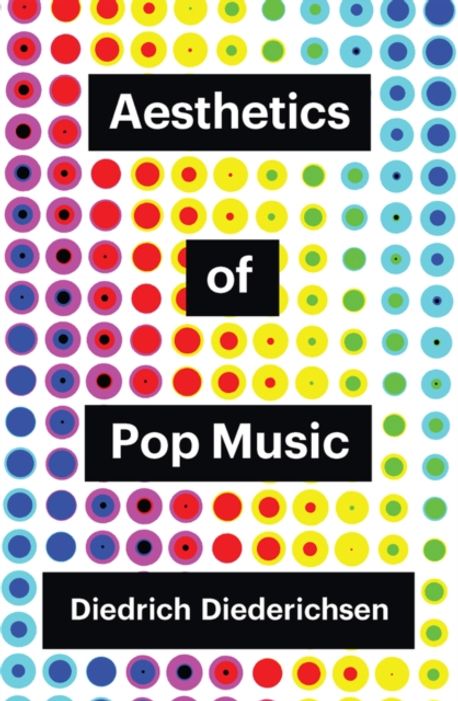
Aesthetics of Pop Music by Diedrich Diederichsen, Hoboken, NJ: Polity Press, 2023
Reviewed for Riffs by Dr G Douglas Barrett, Assistant Professor, TV, Radio, & Film, Newhouse School, Syracuse University (USA).
Aesthetics of Pop Music (2023), the first English-language book by the German cultural critic Diedrich Diederichsen, offers a timely if somewhat idiosyncratic theory of a musical form. Pop music for Diederichsen begins roughly in the 1950s, spanning a range of genres and musicians from Britney Spears to Bo Diddley to John Zorn. It includes yet, as Zorn’s presence already suggests, is not limited to “the popular,” a category Diederichsen is not alone in problematizing. Overall, the project’s goal is to distinguish pop music from music more broadly, with a kind of redemptive ear toward comprehending “later, newer cultural complexes” in danger of being misunderstood (83). Such pop music deserves a genealogy that is both wider and more specific than music, suggests Diederichsen, who neither overstates its critical potential nor fully exempts it from that possibility.
There is a careful attempt to reevaluate, and to some extent revaluate, pop music by articulating just what one might have missed by focusing too much on “the music”—melody, harmony, rhythm. Instead, Diederichsen asks us to attend to pop music as bodies indexed via recordings, to its performances as quasi-libidinal forms of dating, to its forms of connection that elude objecthood, and to its obsession with stances and poses found on stages and record covers alike (2, 56, 130). Diederichsen intimates that these often overlooked elements have critical potential, placing pop music in dialogue with everything from TikTok and porn to experimental music and conceptual art. At the same time, he hesitates to simply transvaluate it as high culture. “To become anything like art, [pop music] must help to shape a world whose traces constitute its own substance—and it must do so from its blind spot, from a position of ignorance, from the mistaken belief that it is only music” (70). Diederichsen’s signature philosophical style: radical possibility arrives wrapped in an aporia—pop music becoming art by mistakenly believing in its musicality.
Positing such a relationship to art may, at first blush, feel unusual for a theory of pop music. Yet Diederichsen’s approach is far from ordinary. Indeed, his engagement with art history and criticism appears alongside an array of intellectual influences: Frankfurt School-style culture industry criticism; German media theory, including Friedrich Kittler; the systems theory of Niklas Luhmann; and cultural studies thinkers such as Stuart Hall. Continental philosophy offers another touchpoint, with sophisticated treatments of Roland Barthes, Quentin Meillassoux, Bruno Latour, and Karen Barad. Somewhat unexpectedly, he leaves references to popular music studies mostly implicit: Diederichsen devotes multiple sections to authenticity, for instance, but does not cite the foundational work of Simon Frith. It makes sense, then, that the author frames his text as more of a manifesto than an academic monograph (vii), where such conventions hold sway. This does nothing, however, to temper Aesthetics of Pop Music’s intellectual stakes.
Indeed, as noted, the book’s core mission is “to separate the concept of pop music from the concept of music” (83). At face value, this appears either paradoxical or straightforward depending on whether the second “music” means “Western art music” or music more broadly. If it’s the latter, pop music can’t exist without some form of music, can it? For Diederichsen, however, pop music is only “partly music” (1). It is, as he explains in chapter 1, an “indexical art” form whose identity inheres in recordings whose contents capture often chance-based or involuntary bodily expressions: medium-based indexical traces that exceed the limits of Western musical notation. This is perhaps the influence of Kittler shining through, shifting attention from traditional musical materials to the recording and storage technologies through which they circulate. Nonetheless, Diederichsen is careful not to essentialize pop music as sound or its recordings: “it would be a mistake to confuse pop music with pure sound art; just like music it is sound art only in part” (9). Instead, he identifies a constellation of features that, in a different register, might be termed “extra musical”: makeup, poses, personas, stars, images, connection, and intimacy.
At the same time, if Diederichsen’s separation is between pop music and Western art music, which he no doubt suggests, such a distinction is uncontroversial, even built-in to everyday language. But here he also goes in the opposite direction, at times outlining more similarities than differences between high and low forms. For example, he describes post-1950s pop music as participating in some of the same “negations” (84) of art music as found in postwar experimentalism’s use of indeterminacy and chance (88). He compares the “small sounds” of John Cage to Lee “Scratch” Perry’s use of non-musical sounds in dub beats. Both have the effect, for Diederichsen, of defamiliarizing the symbolic quality of these sounds, a “desemiotization” that points the listener back to a world beyond the music (88). In another sense, though, pop music flips experimentalism on its head: whereas the latter explores indeterminacy for “new musical material,” pop music uses recordings to capture a technologically reproducible unreproducible, a kind of singularity found in “the phonographically specific” (69). Pop music does this without reflexivity, he contends, “unaware of what it is doing.” As soon as that changes, we get John Lennon composing musique concrète (69).
While critical of the Frankfurt School, Diederichsen aligns with them on this point about low culture’s lack of reflexivity. Yet whereas Adorno and Horkheimer saw the culture industry as a culminating form of mass domination marshaled through the production of media commodities, Diederichsen understands pop music as part of a specific, second stage of the culture industry that, alongside TV, produced new forms of connection and relations between public and private life. Pop music consolidates a form of interiority that seeks connection, Diederichsen suggests, linking the solitary experience of listening in one’s bedroom to broader networks of images and social identities. “[A]n untouchable human body speaks to me alone at night,” he describes a familiar scene of adolescent fandom, “simultaneously comforting me and yet emphasizing my aloneness as the basis of this communication” (46). Underlying Diederichsen’s revision of culture-industry theory is the claim that listeners are not primarily attached to musical works but to mediated persons. Pop music’s central promise is a form of communication with absent others, whose recorded voices and images establish relations of intimacy and identification that extend beyond music’s more conventional materials. If music is those conventional materials, then Diederichsen may be right to separate pop from it.
But is there not another possibility, namely, that “music” can stand for more than melodies, rhythms, and even sounds? Indeed, what if “music” could expand enough to encompass Diederichsen’s whole gamut of makeup, poses, personas, stars, images, and intimacy? After all, the centuries-old form of opera has included many if not all of those elements. Diederichsen knows this of course. But he nonetheless relies on a rhetorical shortcut that tacitly equates “music” with its reflection in absolute music: the nineteenth-century movement that ideologically reduced a more polyvalent concept of music down to instrumental sound. When compared to this form of music, pop music contains virtually everything it seems here to exclude: bodies, desire, sociality, contingency, identification. But many of the book’s strongest examples suggest a different conclusion. Experimental music, opera, jazz, and various non-Western traditions have long incorporated such elements. The question becomes not whether pop music exceeds music, but whether music might be understood as a more expanded field than the one against which Diederichsen defines it.
Related to this question of music’s boundaries is its depth: the relation to high and low that underpins Diederichsen’s media-technological framework. While Diederichsen attends to what recordings communicate to listeners, he seems less interested in what they communicate to musicians. Many pop musicians learn from recordings, a fact that complicates the use of musical literacy—the ability to read scores—to determine musical hierarchy, to separate high from low. If we are to take seriously Kittler’s contention that musical notation and sound recording are both inscription technologies, then recordings appear not merely as vehicles of intimacy and identification but also as alternative systems for transmitting musical knowledge. Recording technology thus destabilizes the historical primacy of the score as a marker of musical literacy. From this perspective, recordings do not simply separate pop music from art music but help explain how forms of expertise once associated with notation circulated through new media forms.
Such expertise also complicates the book’s dichotomy between the self-consciousness of art and pop music’s productive naïveté. For if recordings can function as pedagogical media, they can also cultivate forms of reflection on the conditions of their own production and circulation. One need not deny Diederichsen’s insight that pop music often operates through forms of practical knowledge unavailable to itself as concepts. Yet the history of pop music is also populated by figures—from The Velvet Underground to Public Enemy to M.I.A.—whose work reflects on politics, identity, technology, and the culture industry. Diederichsen’s own account of recordings as technologies of transmission and connection points at times toward a more dialectical relation between reflexive art and unreflexive pop than the book explicitly develops. Rather than a stable opposition, the boundary between them appears as a site of continual traffic and exchange. Aesthetics of Pop Music is at its best when it speaks to this movement.